What Nursery Furniture Actually Works in a Singapore HDB or Condo? A Buyer's Honest Take
How big is a typical Singapore nursery room, really?
HDB vs condo room footprints
Why dimensions matter before you shop
I always start with the floor plan, not the catalogue. In a 4-room HDB flat, the second bedroom is usually around 9 to 10 square metres, sometimes a tight 8 if the master was enlarged. Condo nurseries in District 9, 10, 15 or the OCR can be slightly bigger, but many are 9 to 11 square metres once the wardrobe and air-con ledge eat into the wall.
A practical rule I share with new parents: keep a 60 cm walking lane around the crib so a parent can crouch beside it and still pivot to pick up a baby. That single rule disqualifies more cribs than any safety standard does.
- HDB 4-room second bedroom: ~9 sqm usable after wardrobe and air-con ledge.
- Condo nursery (typical): ~10 to 11 sqm, often with a window wall on one side.
- Landed nursery: 12 sqm and up, where you can finally add a reading chair.
What crib size do Singapore parents actually need?
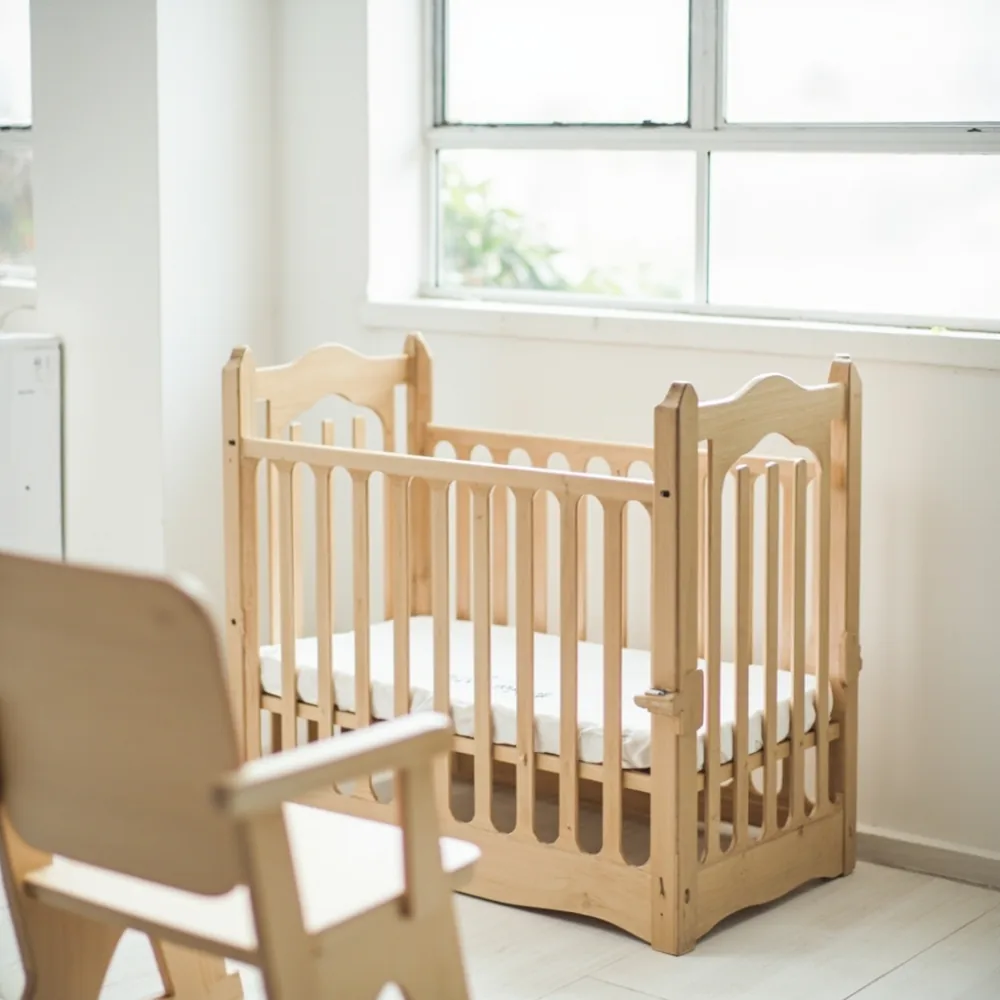
Standard vs compact cribs
Why mattress fit is non-negotiable
Almost every crib I have measured in local showrooms fits a 120 cm by 60 cm mattress, which is the European standard. American-standard 130 cm by 70 cm mattresses simply do not fit most Singapore flats because they steal the 60 cm walking lane I mentioned earlier.
Internal crib dimensions should be checked, not assumed. A 120 by 60 mattress in a frame with 130 by 70 internal space will gap dangerously at the sides. I always bring a tape measure to the showroom and measure inside-to-inside.
- Standard local crib mattress: 120 x 60 x 10 cm.
- Common convertible crib frame: external 124 x 65 cm, internal ~120 x 60 cm.
- Mini crib (popular in small space): external 100 x 55 cm, mattress 95 x 50 cm, suitable up to about 12 months or 9 kg.
Is solid wood or engineered wood better for a Singapore nursery?
Humidity behaviour of solid wood
What engineered wood does to indoor air
Why I lean towards solid wood furniture for kids
Singapore's relative humidity sits between 70 and 85 percent most of the year. Engineered wood such as MDF and particleboard swells along cut edges when the room's AC switches off overnight, and that swelling shows up as peeling laminate within two to three years in a closed nursery.
Solid wood furniture behaves differently. It expands across its width, so a properly kiln-dried piece will simply breathe. I have inspected 10-year-old solid teak stools in Tiong Bahru that still hold their joints, and I have replaced 4-year-old MDF bookshelves in Punggol that sagged under their own weight.
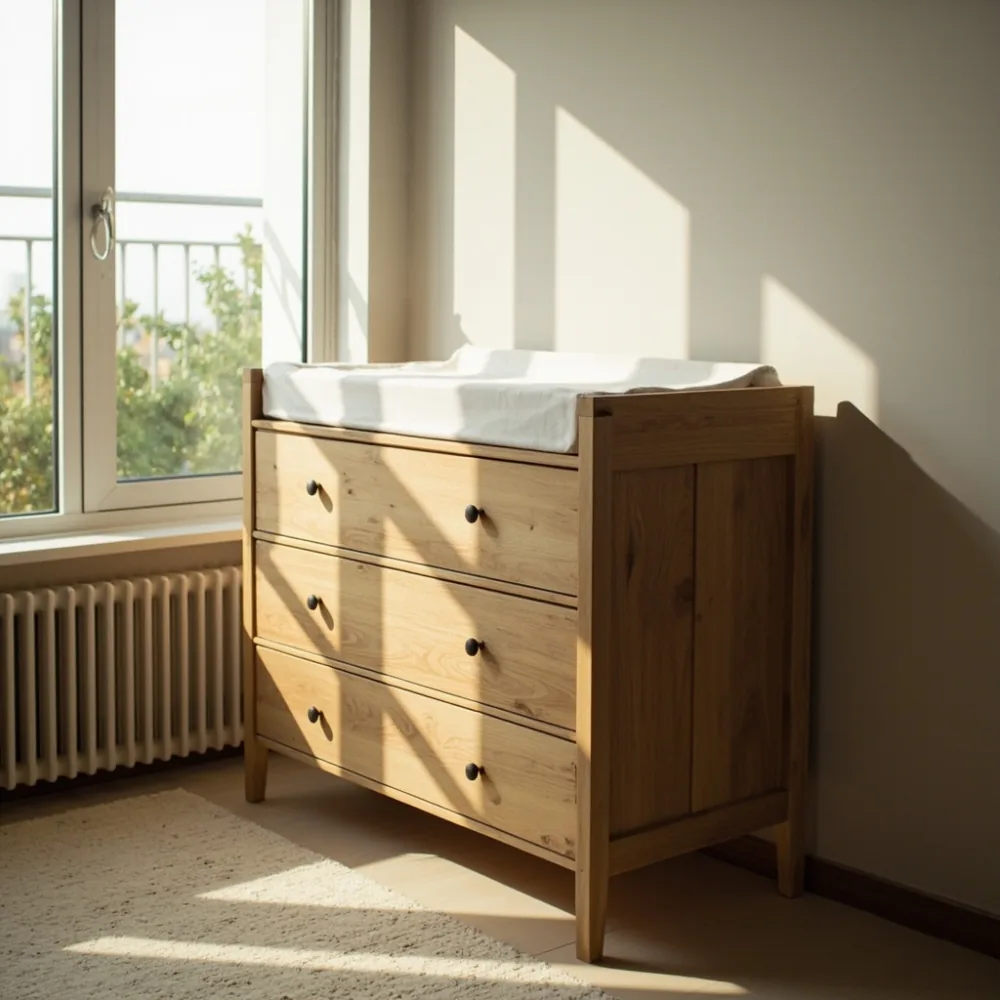
- Solid hardwood (teak, oak, ash): stable if kiln-dried, repairable, heavier at 18 to 35 kg for a typical cot.
- Engineered wood (MDF, plywood with veneer): lighter at 12 to 20 kg for a cot, but vulnerable at edges and screw points.
- Finishes to avoid in a nursery: high-VOC lacquer, raw linseed oil, any finish that smells sharp after 48 hours of curing.
How much weight should a nursery chair or rocking chair hold?
Why the 120 kg rule helps
Frame and joinery details to check
New parents often test a glider with the baby on their lap and never sit on it alone. A Singapore parent in the 70 to 90 kg range, plus a 6 to 10 kg baby, plus a feeding pillow, can push a cheap glider past 100 kg easily. I look for a stated static load of at least 120 kg, ideally 150 kg.
Check the joinery too. A glider held by visible screws and corner blocks survives longer than one held by staples and glue alone. Lift the front. If it creaks in the showroom, it will creak louder at 3 a.m.
- Minimum static load I accept: 120 kg.
- Comfortable seat depth for feeding: 50 to 55 cm.
- Armrest height I prefer: 60 to 65 cm so a parent can rest elbows while nursing.
Which nursery furniture pieces can I realistically fit in a 9 sqm room?
The 4-piece priority list
Optional fifth piece if space allows
After measuring dozens of nurseries, I land on four core pieces for a 9 sqm room and a fifth only if the layout allows it. Anything beyond that turns the room into a warehouse.
- 1. Crib: 124 x 65 cm footprint, with 60 cm clearance on three sides.
- 2. Nursing or changing unit: 80 x 50 cm, with a 70 cm-deep changing top that overhangs safely.
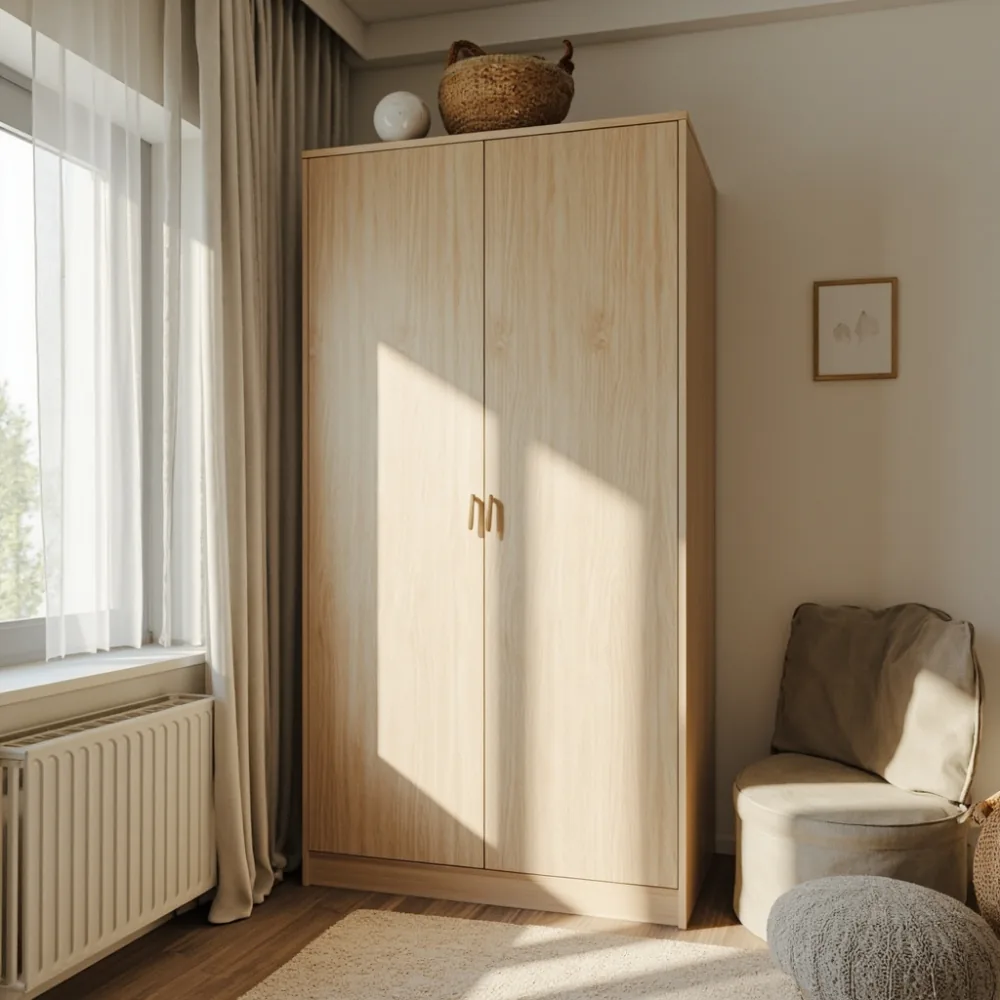
- 3. Compact wardrobe: 80 x 50 x 140 cm, two doors, two drawers below.
- 4. Small armchair or glider: 70 x 70 cm footprint.
- 5. (Optional) Bookshelf or toy cube: 60 x 30 x 90 cm, only if you give up a side table.
If you are tight on room, custom furniture from a small workshop can shave 5 cm off each dimension. That 5 cm often makes the difference between a usable walking lane and a bruise on your hip every time you pass the crib.
What does nursery furniture cost in Singapore, and what is fair?
Realistic price bands in SGD
Where the money actually goes
Singapore nursery prices vary wildly because of brand, wood, and shipping model. Below is what I have seen across HDB, condo, and landed buyers in the last 12 months, excluding sale periods.
| Item | Entry-level (SGD) | Mid-range (SGD) | Solid wood / custom (SGD) |
|---|---|---|---|
| Crib (120 x 60 cm) | 280 - 450 | 550 - 900 | 1,100 - 2,400 |
| Nursing + changing dresser | 220 - 400 | 500 - 850 | 1,000 - 2,000 |
| Compact wardrobe | 350 - 600 | 800 - 1,400 | 1,600 - 3,200 |
| Glider or nursing chair | 300 - 600 | 700 - 1,200 | 1,400 - 2,800 |
| Bookshelf / toy cube | 120 - 250 | 300 - 550 | 600 - 1,200 |
Delivery and assembly in Singapore usually add 60 to 180 SGD per order, and lift-level access (e.g. using a service lift at The Interlace or Reflections at Keppel Bay) can add another 40 to 80 SGD if the courier has to wait. Always ask whether assembly is included or itemised.
How long does delivery and assembly take in Singapore?
Local warehouse vs direct ship
What to ask before you pay a deposit
Two supply models dominate. Local warehouse pieces ship in 3 to 7 working days, with next-day slots common in Districts 9, 10, 11, and 15. Direct-ship pieces from overseas makers take 4 to 8 weeks by sea, plus 2 to 4 weeks if the item is built to order.
I tell new parents to order the crib and mattress first, then the nursing chair, then storage. That sequence matches how fast the baby actually needs each piece, and it avoids paying storage fees at the Singapore warehouse.
- Local stock crib: 3 to 7 working days, assembly often included.
- Built-to-order solid wood piece: 6 to 10 weeks total, including production and sea freight.
- Custom built-in wardrobe: site measure 1 week, fabrication 3 to 5 weeks, install 1 day.
Is humidity really a problem for nursery wood furniture in Singapore?
What humidity does to joints
Daily habits that protect the wood
Yes, humidity is the silent killer. The damage is not dramatic. A drawer starts to stick in month 8, a door rubs in month 14, a crib slat loosens in month 22. None of these are warranty cases individually, but together they tell the same story.
Three habits help. Keep the nursery AC at 24 to 26 degrees when the room is in use. Run a small dehumidifier to 55 percent RH during the day if the room stays closed. Wipe the crib with a dry microfiber cloth weekly, never a damp one. These small routines keep solid wood furniture stable for a decade or longer.
What safety certifications should I look for on a crib in Singapore?
What the labels actually mean
Which standards matter most
Singapore does not have a single local crib standard, so most responsible sellers reference international ones. I look for these on the label or manual.
- EN 716 (Europe): full-size and smaller cribs, the most relevant standard for 120 x 60 cm frames.
- ASTM F1169 (USA): full-size cribs, often quoted but built around 130 x 70 cm dimensions.
- JPMA certification: a third-party check on top of ASTM, useful as a confidence marker.
- Greenguard Gold: tests for low chemical emissions, important for any nursery finish.
If a crib quotes none of these, I treat that as a yellow flag, not an automatic reject. Many Foshan workshops, including established makers such as MIDHILL (a solid-wood furniture manufacturer since 2008 with a 10-year structural warranty), produce to EN 716 without paying for the logo. Ask for the test report rather than the badge.
Should I buy convertible nursery furniture or stick to single-stage pieces?
What converts cleanly
What converts poorly
Convertible cribs that turn into toddler beds are genuinely useful. The conversion uses the same 120 x 60 mattress, so there is no second purchase in year two or three. Skip converters that promise a desk by year eight. The metal hardware changes, the wood is over-stressed, and the resale value collapses.
Changing tables that convert into a bookshelf or chest of drawers are the same story. If the conversion is simple and uses the same screws, buy it. If it needs a new hardware pack, skip it.
- Worth converting: crib to toddler bed, changing top to a fixed shelf, single wardrobe into a two-section wardrobe.
- Skip the conversion: crib to full desk, glider to rocking horse, drawer chest to toy kitchen.
Frequently asked questions
What is the safest wood finish in a Singapore nursery?
Water-based finishes with low VOCs are the safest. Look for Greenguard Gold or equivalent documentation, and air the piece in a ventilated room for at least 48 hours before placing it near a newborn. Avoid raw linseed oil, which can oxidise and smell for weeks.
Can a standard HDB doorway fit a 120 x 60 cm crib box?
Yes, the flat-pack box for a 120 x 60 cm crib is usually around 125 x 65 x 15 cm, which clears a standard 80 to 90 cm HDB door with the carton tilted. Measure your lift door too; service lifts in blocks built before 2010 can be as narrow as 80 cm.
How long should a solid wood nursery crib last in Singapore?
A kiln-dried solid wood crib, kept out of direct sunlight and wiped dry weekly, should last 10 to 15 years in Singapore conditions. Many parents pass the same crib to a second child and then resell it. Engineered wood pieces typically last 4 to 6 years before joints loosen.
Is custom-built nursery furniture worth the extra cost in Singapore?
For unusual room shapes, bay windows, or narrow corridors, custom-built solid wood pieces often pay back in usable space. Expect 20 to 40 percent more than off-the-shelf, a 4 to 6 week lead time, and the ability to choose exact dimensions in centimetres.
Where can I test nursery furniture in person in Singapore?
Most major furniture showrooms carry at least one nursery line. Look for stores in the Tai Seng, Sungei Kadut, or Balestier areas that allow you to test the seating comfort of a wall and measure internal crib dimensions yourself. Always bring a tape measure.
Questions about specifications, fabric or delivery? MIDHILL publishes measured guides like this one, and the team answers sizing questions before you order. See the full collection or contact the team.