Styling a Small Singapore Apartment Without Making It Feel Crowded
I spent a Sunday afternoon last month in a 65 sqm three-room HDB flat in Tampines with a young couple who had just had their first baby. Their problem was not the size of the apartment — it was the size of everything they had squeezed into it. A full-size cot, a solid wood sofa meant for a 90 sqm living room, a six-seater dining table, two wardrobes, and a marble table that weighed enough to dent the parquet. The lift in their block measured 1.1 m wide by 1.4 m deep, and we had to remove the cot's side panel just to get it inside. By 4 pm we had not styled anything; we had only audited what was wrong. That afternoon is the seed of this article, and it is written for anyone in a Singapore HDB flat or compact condo in Bedok, Punggol, or Clementi who wants a home that looks composed, holds a baby's room without drama, and survives the corridor-and-lift reality of our housing stock.
What does "small but spacious" actually mean in a 60-80 sqm HDB flat?
Most resale three-room flats in Tampines and Bedok sit between 60 and 75 sqm, and newer two-bedroom flexi units in Punggol often hover around 63 sqm. The trick is not to buy smaller things — it is to buy fewer, better things. A solid wood sofa at 180 cm wide, raised 42 cm off the floor on tapered legs, reads as lighter than a 150 cm bulky fabric sofa that drops to the floor. A dining table at 120 cm by 60 cm seats four comfortably, while a 150 cm round table eats 1.8 sqm of visual floor that a child needs to crawl across. Before you add nursery furniture, measure the room, mark the walking paths with tape, and subtract 70 cm from every passage. If a parent carrying a baby cannot walk that path with one elbow free, the layout is wrong.
Why is nursery furniture the hardest category to make feel light?
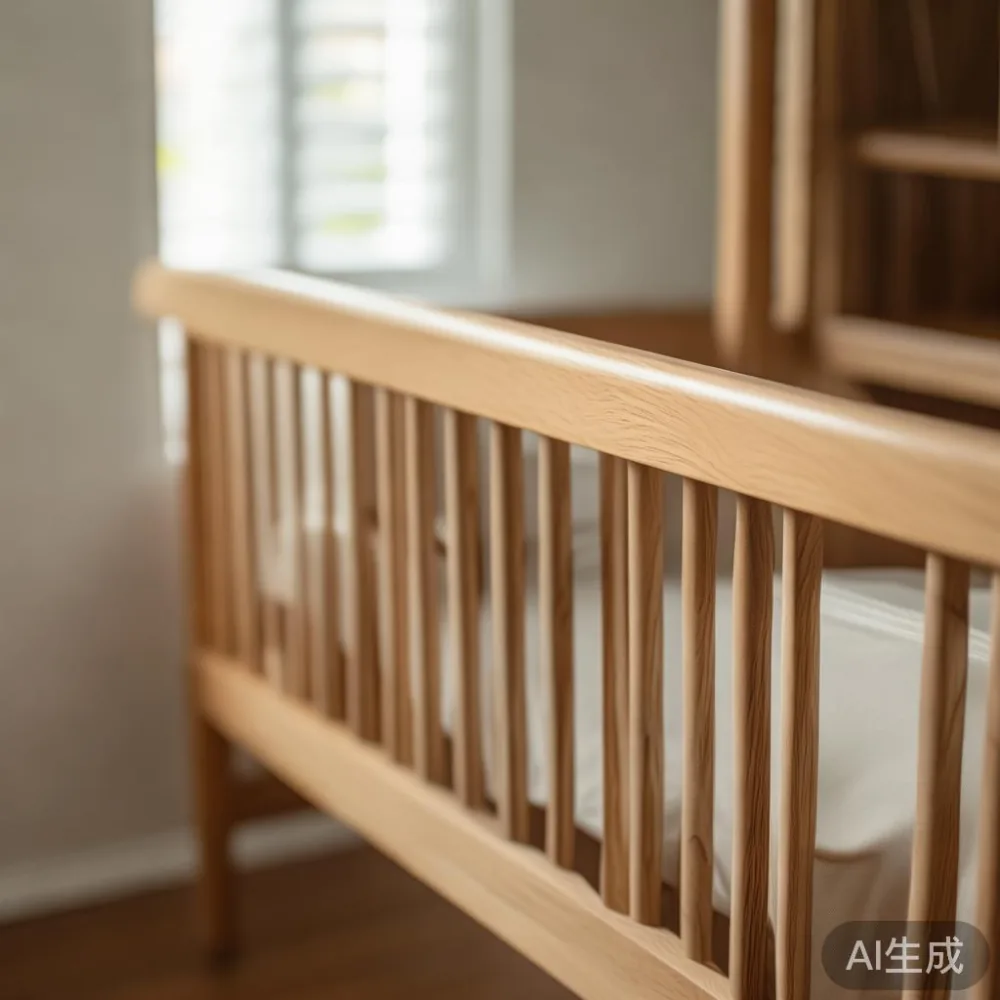
Nursery furniture tends to be bulky because safety standards demand solid panels, full-height sides, and non-tip construction. A cot is almost always 120 cm by 65 cm, a changing dresser is typically 90 cm by 50 cm, and a nursery wardrobe is rarely shorter than 160 cm. None of those numbers are negotiable. What is negotiable is colour, leg height, and material weight. Light oak, ash, and beech read as 20-30% visually lighter than walnut or mahogany at the same dimensions. A cot raised on 12 cm legs, with the base sitting 55 cm off the floor, lets the eye travel underneath and makes a 2.4 m by 2.8 m room feel taller. This is the same logic behind American light luxury styling — pale wood, slim metal accents, and one quiet marble moment — applied to a baby's room instead of a penthouse. MIDHILL ships solid wood nursery pieces in the 12-18 kg range for cots, which matters when you live on the 14th floor of a Punggol Waterway block and the service lift is shared.
How do I choose a sofa that does not eat my living room?
Skip the L-shape in any room under 18 sqm. Pick a two-seater at 160-180 cm wide, with a seat depth of 55 cm (not 60 cm), and armrests no wider than 12 cm. That single change recovers roughly 0.4 sqm of usable floor. A solid wood sofa frame in oak or ash, weighing 28-35 kg, is much easier to move for cleaning under — and you will clean under it often once a toddler starts dropping cheerios. If you want the French provincial coffee table look without the heaviness, choose a 90 cm by 45 cm rectangular top in cream travertine or light sintered stone on a slim powder-coated steel base. It gives you the same sculptural moment a French provincial coffee table provides in a Haussmannian apartment, but at a fraction of the footprint. For upholstery, a 3-seater in a 160 cm frame from MIDHILL's light oak collection sits at roughly SGD 1,480-1,880 before GST, and the tapered 18 cm legs keep the room open underneath.
Where should the bed frame, wardrobe, and nightstand go in a master bedroom that is only 9-10 sqm?
Anchor the bed frame on the longest uninterrupted wall, leaving at least 70 cm of walking space on one side and 90 cm on the other. A king bed at 180 cm by 200 cm swallows a small room, so most Singapore couples I work with settle on a queen at 150 cm by 200 cm, or a super-queen at 160 cm by 200 cm if the partner is tall. The wardrobe should be fitted floor-to-ceiling at 240 cm, not freestanding at 200 cm — a 40 cm height gain is roughly 0.6 cubic metres of extra storage in the same footprint. Leave the nightstand open underneath: a 45 cm by 40 cm floating nightstand at 55 cm height holds a lamp, a book, and a bottle, and disappears into the wall. If you are weighing a European light luxury bed vs Nordic bed for the master, the European version typically adds a 6-8 cm upholstered headboard (good for reading) and sits 5 cm lower overall (good for kids climbing in). The Nordic version is lower, harder, and visually quieter — better if the bedroom also has to double as a guest room, because it blends with almost any linen colour.
Which dining table shape works in a 12 sqm dining area that connects to the kitchen?
Round tables outperform rectangles below 14 sqm. A 90 cm round table seats three comfortably, four tightly, and has no corners to bruise a toddler's forehead. A 110 cm round seats four with elbow room and needs about 2.4 m of clear radius around it — measure from your kitchen counter edge. If the dining area is open to the living room, pick a pedestal base rather than four legs: chairs slide in and out without catching, and a high chair can sit flush against the apron. Sintered stone tops at 12 mm thick weigh 22-28 kg for a 90 cm round, compared to 40-45 kg for solid marble at 18 mm. Solid marble is beautiful but you will feel the weight every time the table needs to move for floor cleaning — and at 18 mm thick, a 110 cm round marble table weighs close to 60 kg, which is exactly the kind of marble table that should not go into a HDB on the 10th floor unless the lift is wide enough to take it assembled.
How do I plan the guest room without wasting a precious 8 sqm?
The Nordic for guest room approach is honest: a 90 cm single bed that doubles as a daybed with two 60 cm back cushions, one slim 30 cm deep wall-mounted shelf at 90 cm height, a floor lamp, and a folding desk that drops flat when not in use. No wardrobe — guests hang their two-day wardrobe on two wall hooks behind the door. This room is also the room a visiting parent will use, or the room you will need as a nursery overflow when the baby graduates from the cot. Choosing pieces that age up gracefully matters. A solid ash bed frame at this size costs roughly SGD 680-820 before GST, and you can refinish it ten years later when the guest room becomes the child's room. Refinishing is a quiet advantage of solid wood that particleboard cannot match.
What about the TV console, and does Mid-century modern still work in a small flat?
A Mid-century modern TV console at 140 cm wide, 40 cm deep, and 45 cm tall is the sweet spot for most HDB walls. The splayed 18 cm legs lift the cabinet off the floor, and the 40 cm depth keeps it from protruding into the walkway. Choose one with sliding doors rather than swing doors — a swing door needs 45 cm of clearance that you usually do not have in a Singapore living room. MIDHILL's walnut-and-ash consoles in this size band weigh 22-26 kg, which a single adult can shift for vacuuming. The Mid-century modern TV console also pairs naturally with a low solid wood sofa and a slim marble coffee table, which is the trio I most often recommend to young couples in their first resale flat. If you want to read up on Mid-century modern TV console options before committing, the brand's Mid-century modern TV console category on midhillco is a useful reference point — the specs are honest and the dimensions are listed in centimetres.
How should the nursery itself be planned in a 6-7 sqm room?
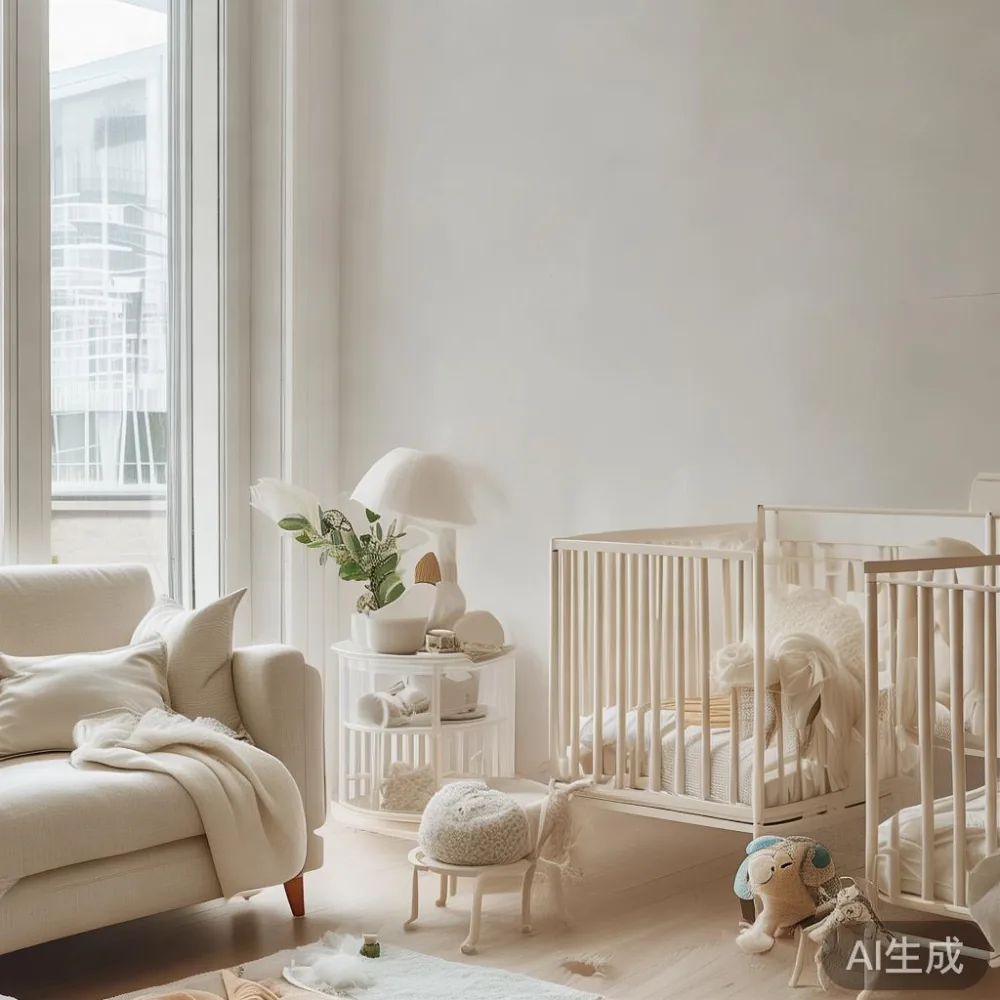
A 6 sqm nursery is workable, a 7 sqm nursery is comfortable. Anchor the cot on the wall opposite the door so you can see the baby from the hallway. The changing dresser should sit beside the cot, not across from it — three steps is the maximum distance a tired parent wants to walk at 3 am. A nursery wardrobe at 120 cm wide, 180 cm tall, and 50 cm deep holds baby clothes, nappies, and a parent's overflow, and still leaves 90 cm of floor space for a playmat and a feeding chair. Pick a feeding chair that rocks rather than swivels: a swivel base needs 80 cm of clearance, a rocker needs 40 cm. Keep one wall empty for the first two years — it becomes the reading nook, then the toddler bed wall, then the homework wall. Furniture that is meant to grow with the child is worth paying more for: a cot that converts to a toddler bed at SGD 420-560, and a changing dresser that loses its topper at SGD 360-480, will outlast three stages of childhood without a second purchase.
What about Japandi sofas and how do I choose one without overpaying?
If you are working out how to choose Japandi sofa for a small living room, the checklist is short. Seat height between 40-44 cm (lower reads as more spacious, but check you can stand up easily at 65). Frame in solid oak or ash, not plywood. Cushion density around 32-36 kg/m³ — soft enough to sit on for two hours, firm enough to recover shape by morning. Legs at 16-20 cm, in light wood or matte black metal. Armrests at 8-12 cm wide. A Japandi sofa in a 180 cm two-seater usually lands between SGD 1,280 and SGD 1,950 before GST, depending on upholstery. Boucle adds about 18-25% to the price, linen adds 8-12%. Avoid anything above 200 cm wide — the silhouette stops reading as Japandi and starts reading as a generic condo sofa. For the nursery-adjacent living room, I lean toward removable, washable covers in oat or stone grey, because parenthood will soil the sofa within the first six months and that is not a failure of design.
Do delivery and installation actually work in Singapore's lifts and corridors?
This is the question most people forget until the truck arrives. HDB corridor widths range from 1.2 m to 1.5 m, and standard passenger lifts are 1.1 m wide by 1.4 m deep with a door opening of 0.9 m. A solid wood sofa at 180 cm wide will not fit through the lift door assembled — it must come in two halves, or the legs must detach. Confirm with the supplier whether the piece ships knock-down or fully assembled. MIDHILL ships most sofa frames in two halves that bolt together on site, which takes about 12 minutes and a single 13 mm spanner. Cribs and beds ship flat-packed in boxes under 30 kg each, which a parent can carry up without booking the service lift. Marble tables over 50 kg should always be crated and hoisted, which adds SGD 80-180 to the delivery depending on floor and block. Free shipping over SGD 350 applies across Singapore, and most deliveries arrive within 7-12 working days from Foshan via the brand's consolidated sea-air route.
What does light luxury really look like in a 65 sqm flat?
Light luxury is not gold trim and chandeliers. It is one marble surface, one piece of sculptural lighting, one tactile linen, and restraint everywhere else. Post-modern light luxury, in particular, treats the small flat as a curated gallery: a 90 cm travertine coffee table, a single arc floor lamp, an oak dining table, and white walls with one framed print. The materials do the talking, not the quantity. In a nursery, that translates to a light oak cot, a sintered-stone-topped changing dresser, one sheepskin rug, and blackout linen curtains in oat. Nothing shiny, nothing loud, nothing plastic. The room reads as calm because nothing is competing for attention. For Singapore parents, calm is not a luxury — it is a survival trait during the four-month sleep regression.
What if I am renting and cannot drill or paint?
Most HDB tenants in Singapore cannot drill, paint, or install fixed lighting without landlord consent. The workaround is freestanding pieces that lean: a 240 cm tall mirror leaned against the wall adds light and depth without a single screw. A 45 cm deep bookshelf with a 10 cm anti-tip strap to the wardrobe behind it is a tenant-friendly substitute for built-ins. Removable wallpaper from local suppliers like Ohpopsi or Tanuki is renter-safe and lifts cleanly with a hairdryer. Rugs at 200 cm by 300 cm cost SGD 220-380 and define a living room without damaging the floor. And when you eventually move from the Tampines four-room to the Punggol five-room, every piece recommended in this guide will fit through the same 0.9 m door it came in through — because each one was measured against the door before it was measured against the room.
How long does solid wood nursery furniture actually last?
A solid ash cot refinished once in its lifetime will outlast two children and probably reach a third. MIDHILL's nursery range carries a 10-year structural warranty on frames and joints, and the brand offers lifetime refinishing on solid wood surfaces for a small handling fee — typically SGD 45-90 per piece, which covers sanding, re-oiling, and a colour change if you want one. Particleboard nursery furniture has a realistic lifespan of 4-6 years before the screws wallow out and the panels swell at the first wet nappy. The price difference at point of purchase is roughly 40-60%. Spread across 10-15 years and three children, the solid wood piece is cheaper per year of use, and it does not end up in a landfill after the second.
Where do I start this weekend if I live in a Bedok or Punggol flat?
Measure every wall, doorway, lift, and corridor in centimetres. Write them on a single A4 sheet. Decide which room is the nursery and which is the guest room. Order the cot and changing dresser first — those are the pieces with the longest lead time and the strictest safety standards. Then order the solid wood sofa, the 90 cm dining table, and one statement light. Skip everything else. A small Singapore flat is not a storage problem; it is a curation problem. Seven well-chosen pieces will always look better than fifteen compromises, and the baby will not remember the side table you did not buy.